
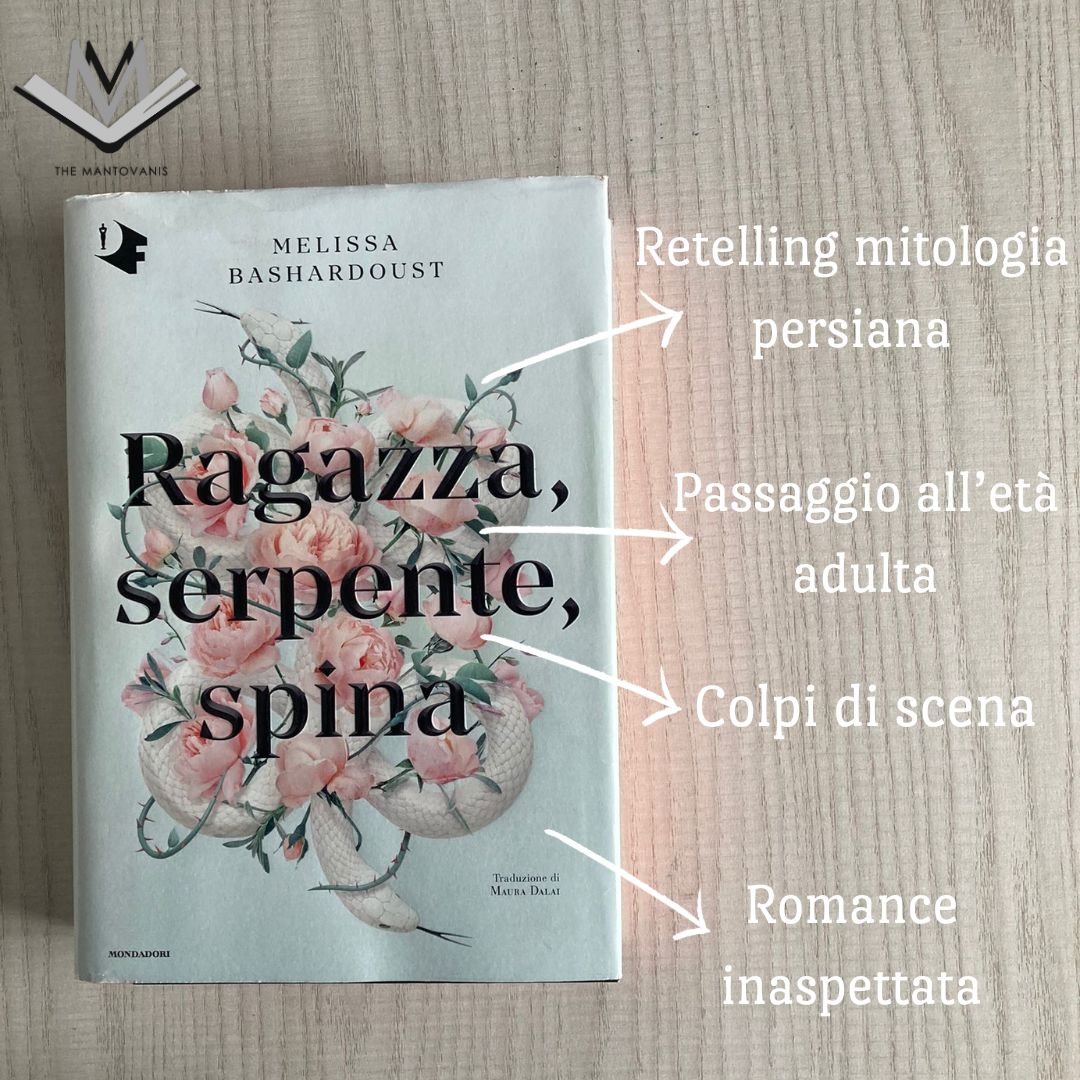

“Ragazza, Serpente, Spina” di Melissa Bashardoust è un romanzo fantasy autoconclusivo, uscito nel 2020 per Flatiron Books e pubblicato in Italia da Mondadori nel 2021.
Soraya è una principessa del regno di Atashar (ispirato all’antica Persia), rinchiusa nel castello non per proteggerla, ma per proteggere tutti gli altri; infatti Soraya, a causa di una maledizione, è condannata a uccidere tutto ciò che tocca.
Gli unici che sanno della sua esistenza sono i suoi familiari e pochi altri eletti.
Soraya soffre per questo isolamento, e vorrebbe trovare il modo per spezzare questo incantesimo; quando un giorno un div (una specie di demone) viene imprigionato nel castello, Soraya decide di interrogarlo. Questo, tuttavia, scatena una serie di eventi che porteranno Soraya a mettere in dubbio tutto il suo mondo.
Il romanzo è ispirato alle fiabe: “Le storie iniziano sempre allo stesso modo: “C’era e non c’era” è l’incipit del romanzo.
Già dalle prime parole ci troviamo trasportati in un mondo fiabesco.
Nonostante il romanzo sia avvincente e ricco di colpi di scena, la scrittura ricorda le poesie mediorientali, grazie anche al world building che prende in prestito parole e miti dell’antica Persia.
Il regno di Atashar viene evocato più che descritto, grazie a dettagli su abiti, cibi e paesaggi che stuzzicano l’immaginazione del lettore senza perdersi in dettagli o descrizioni.
Oltre all’aspetto suggestivo dell’ambientazione, uno degli elementi che più mi è piaciuto dei romanzi è l’attenzione ai personaggi: ognuno di loro incarna un tropo letterario, ma questo spesso viene rovesciato. L’opinione di Soraya su di loro cambia spesso nel corso del romanzo, e il lettore avrà difficoltà a distinguere tra buoni e cattivi fino alla fine.
La storia di Soraya è una vicenda di formazione e accettazione di sé, che passa soprattutto dagli errori che compie la protagonista. Lontana dalle eroine sicure e dalla battuta pronta, Soraya sembra non sapere cosa sta facendo per il 90% del suo tempo; per questo l’ho trovata verosimile come protagonista adolescente.
Anche l’antagonista, per quanto disposto ad azioni di grande malvagità, ha la sua profondità e nonostante la sua mostruosità emerge estremamente umano.
C’è anche molta attenzione a descrivere i rapporti familiari: nelle fiabe questi vengono spesso messi da parte, in quanto i genitori spesso sono assenti o sono matrigne malvagie, i fratelli e le sorelle invidiosi o da proteggere. Questo romanzo prende ognuno di questi elementi, e li fonde in personaggi complessi, con un loro punto di vista che spiega le proprie azioni.
In particolare, mi è piaciuto molto il personaggio della madre della protagonista, forse il centro della narrazione.
È presente l’elemento romance, con una storia inaspettata quanto delicata, che a me è piaciuta molto.
In conclusione, un romanzo che consiglio caldamente agli amanti dei retelling fiabeschi e delle storie di crescita.

“Girl, Serpent, Thorn” by Melissa Bashardoust is a self-contained fantasy novel, released in 2020 by Flatiron Books and published in Italy by Mondadori in 2021.
Soraya is a princess of the kingdom of Atashar (inspired by ancient Persia), locked up in the castle not to protect her, but to protect everyone else; in fact, Soraya, due to a curse, is condemned to kill everything she touches.
The only ones who know of her existence are her family and a selected few others.
Soraya suffers from this isolation and would like to find a way to break this spell; when one day a div (a kind of demon) is imprisoned in the castle, Soraya decides to interrogate him. This, however, triggers a series of events that will lead Soraya to question her whole world.
The novel is inspired by fairy tales: ‘The stories always begin the same way: “There was and there was not” is the novel’s incipit.
Already from the first words we are transported into a fairy-tale world.
Although the novel is gripping and full of twists and turns, the writing is reminiscent of Middle Eastern poetry, thanks also to the world building that borrows words and myths from ancient Persia.
The kingdom of Atashar is evoked rather than described, thanks to details about clothes, food and landscapes that tease the reader’s imagination without getting lost in details or descriptions.
Besides the evocative aspect of the setting, one of the elements I liked most about the novels is the focus on the characters: each of them embodies a literary trope, but this is often reversed. Soraya’s opinion of them often changes in the course of the novel, and the reader will find it difficult to distinguish between good and bad guys until the end.
Soraya’s story is one of self-formation and self-acceptance, which comes above all from the mistakes the protagonist makes. Far from the confident and quick-witted heroines, Soraya seems not to know what she is doing 90% of the time, which is why I found her plausible as a teenage protagonist.
Even the antagonist, though disposed to acts of great evil, has depth and despite their monstrosity emerges as extremely human.
There is also a great deal of attention to describing family relationships: in fairy tales these are often sidelined, as parents are often absent or are evil stepmothers, siblings envious or to be protected. This novel takes each of these elements and blends them into complex characters with their own point of view to explain their actions.
In particular, I really liked the character of the main character’s mother, perhaps the centre of the narrative.
The romance element is present, with a story as unexpected as it is delicate, which I enjoyed very much.
In conclusion, a novel I highly recommend to lovers of fairy-tale retellings and coming-of-age stories.
 The Mantovanis Blog
Sembra interessante, mi piace quando non è ben definito chi siano “i buoni” e chi “i cattivi”!
"Mi piace""Mi piace"